
Matt Witten’s speculative fiction 51% was just released. On a call from a writing retreat in Wales, he told us about his book and the process of turning it into a TV show. The conversation was edited for length.
Please tell our readers about your new novel, 51%.
This is the first speculative fiction I’ve ever written. I had tremendous fun writing it. I know it’s kind of a dark world that I’m portraying, but for some reason, I really enjoyed writing it. It’s a story about the way the United States could be in 20 years. I used to say 30 years, but since Trump got elected and things have been deteriorating. I’ve changed it to 20 years.
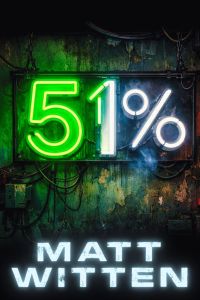
It’s about a world where the government is even more ineffective and gridlocked than it is now, and the big corporations have even more power, and they’ve gotten even bigger. [In the book], there are six corporations that own most of the United States. Imagine Elon Musk and these other characters like him getting even more powerful and consolidating their wealth.
They own schools, they own roads, they own police departments, and they even own people. A lot of people are 51% owned by the corporations, and they’re like indentured servants. The NYPD has now become the NYPD Incorporated, and for instance, if you’re a homicide detective, like two of the heroes of the book, then you not only have to solve the murder, but you also have to raise the money yourself to do so. You have to get money from the victim’s family, or their neighbors, or their church, or you do a crowdfunding campaign.
And so our detectives in the story have to make the decision about how hard they’re going to investigate the murder of a poor young immigrant woman who will not be a great source of income. They might work for a week to solve her murder, if they can even solve it, and only get 20 bucks for it. There’s an old saying that, in every generation, a new evil arises. And in every generation, people of goodwill have to fight back and save our democracy. So those are the forces that I see at play in this.
What made you turn towards speculative fiction?
I went to see a lecture by a guy named David Nevins, a TV executive who was involved in great shows like ER, The West Wing, and Homeland.
He said that the great TV shows are the ones that talk about our deepest fears. And to that, I would add, by the way, deepest hopes. And I thought, what are our deepest fears? And the two words that just came to me were student loans. [One way of becoming one of the 51% who’s owned by the corporations in this novel is by taking out student loans.]
Can you tell us about making this into a show?
My TV/movie agent, Paul Weitzman, of Culture Creative Entertainment, said that this would be a great TV show. He set me up with some pitch meetings with producers. And I pitched to, I think, about 10 of them. And one of them responded, Madison Wells is the name of the company. They thought it would be good if I paired up with an experienced TV showrunner. Because I’ve worked on TV a lot, but I’ve never run a show.
So, I said, well, how about my old friend Charlie Craig, who’s very experienced? So, Charlie and I then together worked on creating a 15 to 20 minute pitch. We pitched it to about four or five of the networks, and NBC said yes and hired Charlie and I to co-write the show. We worked on an outline, which is maybe 10 to 15 pages single-spaced. about what the pilot would be. We then give the outline to the producers, they give us notes, and then we give it back to them, and then we give it to the studio, and the studio gives us notes, then we get it to the network, and they give us more notes. Then you write the script, and then you write the second draft, and you get notes along the way. What I just described is a pretty standard process for any TV pilot that the network has hired you to write.
I’m sure authors reading this will be curious about the process of developing a successful pitch. Any tips?
I actually sometimes teach a course in this. You want to have a great central idea, a great character, and a great central conflict. You need to be able to express the entire show in a sentence. So, for instance, if you were pitching the TV show House, your sentence might be, “a brilliant doctor who hates people, cures people.” Then I might say something about the fact that he has an injured leg, which is caused by a bad diagnosis, so maybe that drives his interest in diagnosing people. I might want to say that he is a Vicodin addict and talk about his relationships with the people who work for him and his boss a little bit.
Practice your pitch on other people. Have a character who really wants something desperately. You want that character to have really high stakes. You want them to really, really want something. That’s why we care. And there’s some real obstacles in their way that they have to fight through. And we know that those obstacles and that desire by the character will last for the whole series.
It really helps if you can just show your passion for your idea. And it doesn’t have to be that complicated. For instance, if you want to do a show about John Brown, the abolitionist back in the 1850s, you can say, “I’ve been fascinated by John Brown my whole life. As a kid, I read books about him, and I’ve been reading about him for the past 20 years. I’ve always wanted to do a show about him.” And think for yourself, why is it I really want to tell this story? That’ll help make the story better.
Most authors usually work alone. What was it like to work with a co-author? What were the mechanics of the collaboration? For example, were you together in the same room to write? Did you divide up chapters between you, etc?
Well, working with Charlie was a dream. It’s absolutely the best collaborative experience I’ve ever had in my life. We were both on the same page, and I just really enjoy him. When we were working on the outline, we worked on Zoom, and we had some software where your screen would look like a bunch of index cards, and on each little index card, you’d write the scene in a sentence. That’s called a one-liner or it’s also called breaking the story. Maybe when I say a sentence, that might be exaggerating, might be one or two or three sentences. And so we’d have the index card, and we’d put it up on the “board.” We’d write these index cards for the whole show, and we’d shuffle them around, and get rid of some, and put new ones in, and adjust them, and eventually we had an outline. Then once we agreed on the one-liners for each scene, we divided them up. And then when it came to the script, we did the same thing. One of us would take all the scenes with one character and the other would take the scenes with another character.
What if a network or any other stakeholder wants to go in a different direction from the book, with a character, or even the storyline? Who decides?
Well, the short answer would be, the network decides. And the longer answer would be that you try to find something that everybody’s happy with. And in this case, you know, we were happy with everything. I’d say the biggest thing we had to figure out with the network was, how much of the pilot script is going to be our cops? And how much is going to be other characters? In our first conception of it, each cop was going to be about a third [of the script]. And then the network said, no, we’d rather have the cops be more emphasized. So we said, okay. And so we rewrote it, and I ultimately thought that made it a better pilot,
What’s next for you?
Back before I started writing for TV, I wrote four amateur sleuth cozies, the Jacob Burns Mysteries. My next book, I don’t know if I’d call it a cozy mystery, or an upmarket mystery, or a book club mystery, but it’s somewhere in those categories. It’s called The Men’s Group. It’s about five men who have breakfast every Sunday at a cafe in Los Angeles. They’re a very wide group of people. One of them is a 28-year-old man who’s a carpenter who’s been living in his van for the past three years. Another is a 74-year-old retired contractor who just got married for the first time at age 72, and he has no idea what marriage is supposed to be like, so he’s always asking the other guys if his marriage is normal. There’s a TV writer like me, and then there’s a cannabis entrepreneur in his forties. And then there’s a pest exterminator. So it’s a really wide variety of people, and the reason they’re all together is because they’re all in AA. This is where they go after their Sunday morning meeting, and they’re anywhere from, you know, 3 to 25 months sober.
It’s a book about male friendship, love, and kindness. And of course, there’s a murder. The pest exterminator, I’m sorry to say, gets murdered. And the police think it’s a Ketamine overdose, because it was Ketamine, but the other guys just don’t believe it, and so they’re gonna find out who killed him. And in the process, they start to suspect some of their AA brothers. They find out that some of the people they’ve shared their hearts with may be a little more complicated than they realize.
It’s inspired by my own story. I’ve been going to an AA men’s group for the past 20 years at the same breakfast place. There was a fire in LA last year, of course, so my house burned down, the whole neighborhood burned down, and this particular restaurant, which was called Matthew’s Garden Cafe, that also burned down. So, it’s also kind of my love letter to the place.
