
firstCLUE Interviews
Etta and Brian talk to authors of books they love.
Erica Ferencik
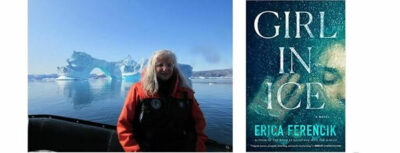
Author of Girl on Ice Published Gallery/Scout Press (March 1, 2022)
According to her website, “There is nowhere on Earth Erica Ferencik won’t go to take you out of your head and into the great wild world. An award-winning novelist, Ferencik writes adventure novels featuring women who brave not only internal struggles but face extreme challenges in their environment: remote forests, steaming jungles, and desolated icescapes.”
Ferencik’s latest, Girl in Ice, certainly fits this description, but with characters so memorable we are still thinking about them ten months after reviewing the novel.
firstCLUE spoke with Ms Ferncik in 2022:
The character of Sigrid—a girl who was frozen in the Greenland ice hundreds of years ago, only to come back to life—has remained a powerful memory. What was your inspiration for Sigrid?I think the inspiration for Sigrid evolved from the inspiration for Girl in Ice itself.
One bitterly cold morning in the winter of 2018, I was walking in the woods near my home, and came upon three juvenile painted turtles frozen mid-stroke in the ice along the shallow edge of a pond. They didn’t look alive, but they didn’t look dead either…
It turns out there are some animals (and plants too!) that have this freezing-and-coming-back-to-life thing down. Painted turtle hatchlings, some species of beetle, wood frogs, certain alligators, even an adorable one-millimeter length creature called a Tardigrade or “water bear” that can be frozen to -359C and thaw out just fine. Most of these creatures possess a certain cryo-protein that protects their cells from bursting when they freeze.
A protein that…we don’t possess. Still, the image of a young girl frozen in a glacier in the Arctic popped into my head. From there, I asked myself: How did she get there? What was her story?
This young girl became the heart of the story in many ways, a kind of fiercely hopeful character. But she was also a warning: her ancient society had come to blows over resources made scarce by its own climate disaster, resonating with what may come to pass in our own not very distant future.
Val, our narrator, who specializes in ancient Nordic languages, is a troubled soul. But her attempts to communicate with Sigrid are fascinating and poignant. Would you describe Val as transformed by her sojourn in Greenland?
Absolutely. The title Girl in Ice could refer equally to Val, in her prison of anxiety, as much as Sigrid, in her prison of ice. Val’s anxiety disorder meant that she only felt comfortable in a few settings: her home, her office, the local grocery store. For her to travel to someplace as remote, foreign, and ominous as Greenland was unthinkable at first.
But Wyatt’s email begging Val to come to Greenland contained something that changed her mind: a clip of Sigrid’s speech. Even though Val didn’t understand a word of the clip, she heard something in the girl’s voice that moved her more than she thought possible, and that was fear, trauma, and confusion. Finally, Val thinks, “How could I stay here, knowing I might hold the key to unlocking a living human child’s desperate needs, tragedies, secrets?”
Certainly, by the end of the novel, Val discovers sides of herself she never thought were there.
All three of your novels are unique and compelling in how they use suspense to marry the experience of humans and the threat of nature—and here nature is even more threatening due to global warming. What made you so interested in these narratives?
I love any great story no matter where it’s set; however, I’ve got a real soft spot for any novel or film set in a forbidding place. I could speculate all kinds of deep psychological reasons for my love of survival stories. Let me put it this way: like so many others, I survived an extremely challenging childhood, and so I have ready access to dread, to feeling trapped, to planning creative ways to survive. In short, my fight or flight hormones are quite close to the surface.
The second part of your question—how nature itself has become and will become more threatening to us in many ways, due to global warming—is something I’m pretty much obsessed with. As recently as fifteen years ago, I thought of climate change only occasionally; now it seems to invade every other thought. I’m not sure I know how to write stories that don’t involve, somehow, this existential threat. That said, climate change and its impacts—and other “topical” stories—never appear my narratives because they’re topical, but because they are an integral part of the story.
Robert Lloyd
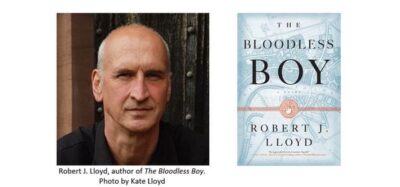
Author of The Bloodless Boy Published by Melville House November 2021
In the August 19 issue of First Clue, we ran a starred review of Robert J. Lloyd’s “meticulously researched and written” The Bloodless Boy, which takes readers back to 1678 London, where an assistant to physicist Robert Hooke investigates a series of murders. Lloyd recently told us more about his book, his unusual investigator, and how today’s politics influenced his writing.—Henrietta Verma
firstCLUE spoke with Mr Lloyd in 2021
Apparently, people were no less politically upset in the 17th century than we are today. Reading the book, I felt parallels with our era, but was still immersed in that long-ago world. Were you conscious of treading that line?
Very conscious, and everything being grist to the mill I was able to use what was going on while writing The Bloodless Boy to inform the way my characters react to things, and especially their prejudices. I started the novel in the year 2000, using Frederick Forsyth’s book The Odessa File as a model: breaking it down, looking at chapter lengths, where he changes point of view, how much of a page is description, how much is dialogue, how much is action (surprisingly little!), and so on. In that book, the Odessa organization, busy helping ex-Nazis, is threatened by the evidence of an old man’s diary, which describes his time as an inmate in concentration camps.
The Bloodless Boy is set in a time and place which was virulently anti-Catholic. I remember reading Ian Paisley’s speeches for inspiration for my character Israel Tonge, who enjoys a rant. In September 2001, of course, Osama bin Laden attacked the U.S., and the U.S. retaliated, with the assistance of Tony Blair. So, in the U.K. we saw the rhetoric against Muslims change pretty well overnight, either coming from politicians or from the media. Whether racist, religionist, or both, people became evermore outspoken, and incidents of Islamophobia increased, as well as violence. Seeing these parallels, I began to rewrite the main character. Harry Hunt sees through the prejudice, is unswayed by it (after a few wavers), and finds out what actually happened. (In other words, who did it.) In this way, he utilizes the credo of the early Royal Society, whose Fellows, after the Civil Wars, were anxious not to let zealotry stop you seeing things “as they are.”
Robert Hooke’s work as a physicist is richly described here and was the subject of your MA thesis. He’s an unusual character to have brought in—can you tell us which came first, the story or the decision to write about this figure? And you must have spent years with Hooke by now—what’s that like?
First came the decision to write a thriller, then the realization I already had a load of research done during my MA. Rereading Hooke’s diary gave me some of the main events I wanted, for example, a pickpocket falling to his death from the Monument to the Fire of London. In the first drafts of the novel Robert Hooke was my main investigator, and he spent his time ordering Harry Hunt to do his bidding. This made Harry very passive—he lacked agency. It became far more interesting when Harry disobeys Hooke, continuing with an investigation Hooke wants no part of. Also, when focusing on Hooke, I couldn’t write the action scenes I wanted to, as by his late thirties he was severely hunchbacked. Fighting villains on top of the Monument seemed unrealistic.
I have spent years with Robert Hooke now, and find him endlessly fascinating. I have conversations with my imaginary version of him. I do separate the two, the real and “my” version, otherwise I’d feel terrible guilt at making him do and say things that don’t paint him in the best possible light. I’m such a fan, but my fiction would be very dull if he were just amazing in every aspect. Although I want physical details to be right, and I inform my fiction with a lot of research, I still purvey, after all, historical fiction.
When I started writing The Bloodless Boy, there was very little about him—Margaret ’Espinasse’s biography from 1956 was the main source of information I had, along with Birch’s History of the Royal Society and John Aubrey’s “Brief Life.” The tercentenary of Hooke’s death, in 2003, brought a flurry of new publications. Lisa Jardine’s and Stephen Inwood’s biographies gave me new information and suggested more sources to explore. The discovery of the Hooke portfolio was amazing! It seems to have gone quiet recently on Hooke as far as books being published goes. Hopefully The Bloodless Boy will reinvigorate some discussion about this extraordinary man.
The next book in the series, The Clockwork Assassins, will be published by Melville House in November 2022. Can you give us a sneak peek as to what your sleuth, Robert Hooke’s assistant Harry Hunt, will be up to this time?
Book 2 is to be retitled as The Poison Machine—I was never happy with the original name. Captain Jeffrey Hudson, who was Queen Henrietta Maria’s dwarf and a soldier during the Civil Wars, and who shot a man in a duel (this is all real, by the way), is found dead in the Cambridgeshire Fens. Only, everyone thought he was still alive. Harry is engaged to find the imposter, his search taking him to Paris, where he becomes embroiled in the Affair des Poisons, and where he uncovers a plot against the Queen (Catherine, this one). He must race back to save her. Book 3 is well under way, and I’ve spent quite a lot of time planning book 4.
And, finally, are you reading anything that you’d recommend?
I’m in the middle of Retribution Road by Antonin Varenne, translated by Sam Taylor. For my birthday recently I received six books to be “curated” for me by a bookshop in Bath. I had to fill in a detailed questionnaire, then they send books they think I’ll like. I have to say, for their first go they’ve got it spot on. One thing I notice is how good the translation is, in terms of the rhythm of the sentences. I’m in a bit of a rich vein of form at the moment: I just finished The Weight of Ink by Rachel Kadish, which I think is stunningly good. As research for book 3, I’m reading Roy Porter’s Madmen: A Social History of Mad-houses, Mad-doctors and Lunatics.
Jane Pek
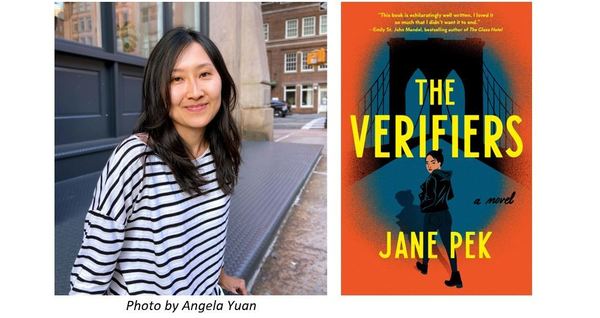
Author of The Verifiers Published by Vintage February 2022
| Jane Pek was born and grew up in Singapore. She holds a BA from Yale University, a JD from the New York University School of Law, and an MFA in Fiction from Brooklyn College. Her short fiction has appeared in The Brooklyn Review, Witness, Conjunctions, Literary Hub, and twice in The Best American Short Stories. She lives in New York, where she works as a lawyer at a global investment company. Pek’s first novel, The Verifiers, publishes this week. Reviewing it in September, we wrote that “A smart, witty amateur detective has entered the crime fiction galaxy, and you won’t want to miss her… For readers who enjoy quirky characters, strong female leads, and love/hate family relationships.” firstCLUE spoke with Ms Pek in 2022 Claudia Lin is a great hero: complex, funny, unabashedly truthful (except when keeping her sexual identity a secret from her mom), a biker with a love for Jane Austen. Did she, and her voice, arrive full-formed, or did you spend months creating her? The answer is a bit of both! Claudia and her voice did arrive full-formed – but they arrived pretty late in the novel-writing process (after years, not just months). For the first few years that I was writing the book, I was working with another protagonist altogether, and also in the third person). In hindsight, I think that was part of what took me so long to pull The Verifiers together: I didn’t have a clear idea of who my protagonist was and so how she would act and behave in situations. Then I had an epiphany that my protagonist should be Asian-American—which she wasn’t originally—and once I realized that, I knew who she would be and what her voice would sound like. I love the confidence of this book, that you created a crime novel that’s a bit of a cozy, a traditional mystery, a literary novel, and even part techno-thriller. What inspired you to step a bit outside the crime-fiction genre and create a book so unique? I grew up reading genre fiction, including classic mystery writers like Agatha Christie and [characters like] Sherlock Holmes, although I must confess, my first love is actually fantasy. As a writer, I’m very interested in writing stories that play with and utilize elements of genre, while at the same time focusing on character development and the interior worlds of the characters the way literary fiction traditionally does. So, I knew that whatever I wrote, it would involve elements of genre, while also hopefully coming across as more than a straightforward entry in a particular genre. I didn’t actually know from the start that The Verifiers would end up as a murder mystery. I came up with the premise of an online-dating detective agency, but for a time I thought that the types of mysteries in question would be quieter ones: why someone would lie about who they were, why a relationship wasn’t working out. It appears, though, that where there’s a detective agency, murder is likely to follow … Veracity, the company Claudia works for, checks the truthfulness of the information participants on dating sites provide about themselves. Could this actually be happening today? Is it set a bit in the future? Or is it just a cautionary tale? I think of the world of The Verifiers as being set in the present day, but with a few tweaks that make it distinct from our world: the conceit of the matchmakers, the various fictional pop-culture references. And I do think all the technology in the book already exists today, aside from the level of sophistication of the synths (maybe). However, I suspect that Veracity’s business model might not work that well in real life! If I had to guess, I’d say that the online-dating platforms themselves will get better at policing the truthfulness of what their subscribers say, as they collect more and more data about us. Finally, I’d love to see Claudia emerge as PI. Any chance we will hear more from her? Nothing is officially in the works, but I would love to write more books about Claudia and the Lin family and the other verifiers! |