In her fiction debut, Madden gifts readers with a complex psychological story that explores the lasting effects of violence and who controls the narrative of trauma. The novel unfolds from the alternating perspectives of three women whose lives are linked by one man, Calvin, who has just been murdered. They are Birdie Chang, a woman who was sexually abused by Calvin and is now on the run from him; Linzie King, another victim of Calvin’s, a former reality-TV star who has published a bestselling memoir about her experience; and Mary-Beth, Calvin’s devoted mother, who fiercely defended him throughout his legal troubles and struggles to reconcile the son she loves with the person capable of such actions. Moving across their voices and time, from Whidbey Island’s lush cool green to a sticky, tacky North Pole gas station in Florida, each woman examines what part she played in Calvin’s actions. A cast of secondary characters fills in the blanks. There’s Syl, Mary-Beth’s sister, who wonders why she ever allowed Cal into her home, which put her twin daughters in danger. And Rich, who meets Birdie on the ferry to Whidbey and offers to “take care of” Calvin for her, as well as Trace, Birdie’s girlfriend, who travels to Florida to do that herself. Madden masterfully captures the haze of lost and found memories, the urges to take revenge, and the regrets of those who knew, but did nothing.—Dodie Ownes
Lesbian
Raya, Isha. You’ll Never Forget Me. January 13, 2026. 304 pages. Bantam. DEBUT
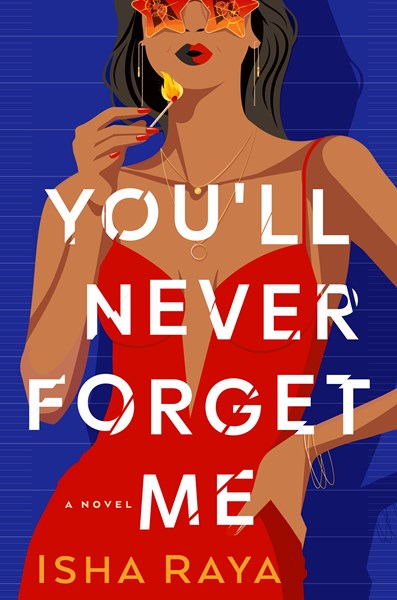
Always a bridesmaid, that’s Dimple Kapoor. She looks so like her rival for movie roles, Irene Singh, that they can’t be in the same movies. Casting directors must choose one or the other, and it seems they always go for Irene. It all comes to a head at a glitzy party at Irene’s Hollywood home. The two verbally spar at the top of some stairs, and Irene ends up at the bottom, dead, after a push from Dimple, who suddenly finds her career taking off as a result. All’s fair in love and movie roles, right? But Dimple learns to her horror that someone saw what happened and has evidence. As she takes care of that situation, too, ruthless private investigator Saffi Mirai Iyer is on to her and laser-focused on getting justice. The clash of two women who are twinned in their ambition and inability to back down, but completely different in their goals, creates an absorbing moral game, while the spoiled Hollywood expectations of the main character adds a delicious love-to-hate element. Dimple is the bridezilla of actresses and readers won’t be able to look away from this fast-moving debut thriller.
© 2025 firstCLUE Reviews
Subscribe to our newsletter today!
![]()
A characteristic that makes mysteries such a popular genre is that the concept of right and wrong is so often very clear. Not so much here. Robbie, our heroine, and Dee, her queerplatonic partner in a gay karaoke bar in a nothing Indiana town, are both successful contract killers. Their jobs are done quickly, cleanly, and without emotion, except for Robbie’s latest one. The information on the local target is sketchy and the target himself suddenly disappears. She can’t afford to return the deposit because she and Robbie have sunk all their money into a theatrical venture, and besides, it feels all wrong. Instead of ignoring who the target is, she works hard to find out the exact opposite. We have local politicians, Robbie’s musical ambitions, and the lively karaoke scene all tangled up with a client who just won’t quit in his effort to have this target done away with. Heath provides a fun story with a great deal of gender and identity fluidity. There is a happy ending of sorts, but is it right?
In no way could this novel ever be described as a mystery. And yet it is chock full of mysteries, large and small, some poignant, others humorous, all deeply compelling. Darcy, a public librarian, has returned to her job after suffering through a nervous breakdown that was serious enough to have her institutionalized for a spell. Even though she’s queer, with a wife she loves, learning about the sudden death of her boyfriend from years back pushes her into despair, obsessed with understanding what could have killed him. When she returns to work (presented 100 percent accurately BTW), it’s with understandable trepidation. Patrons are still watching pornos, finding inventive ways to harass one another, protesting both for and against book banning, and expressing anger over DEI. In every way, Is This a Cry for Help? is hugely prescient as it demonstrates how community, colleagues, partners, spouses, humor, and especially libraries can come together to help us survive and thrive.
In this Korean bestseller, police detective Suyeon is called to the scene of the fourth suicide of an elderly patient at a crumbling hospital in a deserted part of Incheon. Her boss believes the deaths, spurred perhaps by pervasive depression and loneliness, are coincidental and sees no point in investigating further, especially since their families had abandoned the dead. But Suyeon thinks something is off. All four victims, who suffered from dementia, jumped from the hospital’s sixth floor, but very little blood was found at the spots where they landed. Returning to the hospital later that evening, Suyeon encounters a mysterious Korean-French woman named Violette, who tells her, “A vampire did it.” A skeptical Suyeon angrily dismisses Violette until the autopsy of a fifth suicide reveals two puncture holes in the victim’s neck and the body drained of blood. Claiming to be a vampire hunter, Violette explains to Suyeon that someone at the hospital is helping a vampire target his next victims. As Suyeon seeks to identify that particular nurse, the narrative shifts back to 1983 France, when a teenage Violette, adopted by loving French parents but feeling isolated and lonely because of her Koreanness, begins a strange, intense, almost Sapphic friendship with the enigmatic, barefooted Lily. Skillfully translated (but a glossary of Korean terms would have been helpful), Cheon’s novel is more than a queer paranormal mystery (the inconsistent vampire elements are its weakest parts); instead, it’s an eerie and bleak portrait of societal loneliness, isolation, and marginalization.
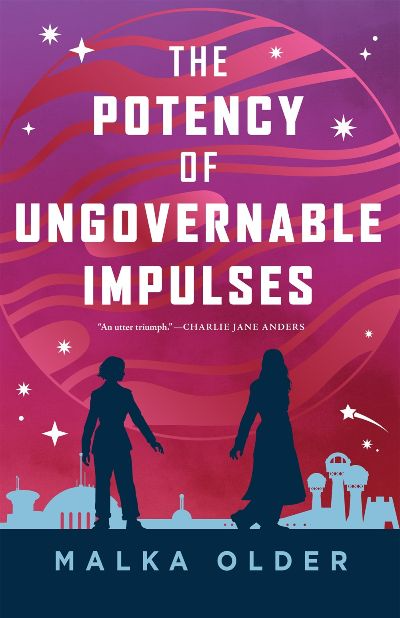
Our favorite otherworldly investigators, Mossa and Pleiti, Jupiter-residing gay gals with a whole lot of know-how, are back. Or at least Pleiti is back, having been called up to help a good friend’s cousin, Villette, who is about to undergo her donfense, a sort of doctoral defense. Reluctantly, Pleiti agrees, despite the lengthy trip out to Stortellen University, located at the furthest reaches of the planet. But there are problems. Number one is that Villette is being accused of plagiarism—a false accusation but hard to shake. Problem number two is the absence of Sherlock-like Mossa, who is a no-show, leaving Pleiti alone to keep Villette safe while missing terribly her affectionate relationship. Thankfully, this is a short novel, whereas the earlier works (The Imposition of Unnecessary Obstacles, The Mimicking of Known Successes) were novellas. This gives Older some room to play, including in the bond between Pleiti and Mossa and the wonderful use of language (since the early settlers, after all, spoke a breadth of languages). Don’t be lazy, look the non-English words up; it’s half the fun. A unique series that just keeps getting better.
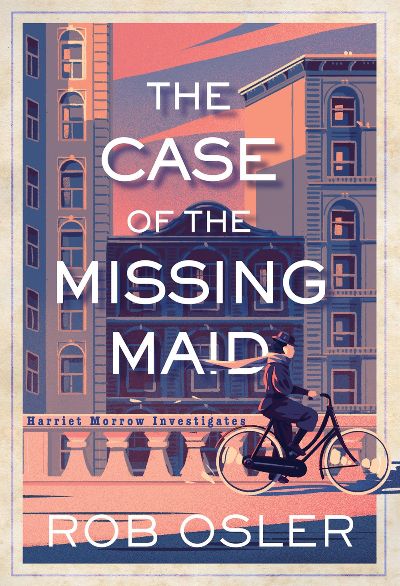
A wonderful foray into turn-of-the-19th-century Chicago, with women entering the workforce, immigrants transforming the city, and the LGBTQ community tucked away in hidden nightclubs. Harriet Morrow, all of 21 years old, is the first woman hired as a detective by the prestigious Prescott Agency—a decision that pleases almost no one, neither the male detectives nor the female typing pool. But working as a detective has always been a dream of Harriet’s, and now, with her parents dead and her younger brother to support, it’s a necessity. So too are the pants she wears, giving her the freedom to comfortably bike around Chicago while also exploring her identity as a lesbian. Within an hour on the job, Harriet gets her first assignment: to find a maid who has disappeared from one of the posh mansions on Prairie Avenue—and Harriet has only a few days to locate her. It’s magical how Osler transports us around Chicago, from the the large Polish community to queer social spaces to the ritzy homes of Chicago’s elite. Harriet is a wonderful lead character, and Osler brilliantly combines his protagonist’s growth into adulthood and Chicago’s emergence as one of the nation’s largest cities. This book is asking to be the first in a series
The many fans of Jane Pek’s first book, The Verifiers, will be thrilled to get their hands on this new novel featuring the indomitable Claudia Lin. In this darker and tougher novel, with a robust comic streak and a deep foray into technology—featuring synths, the scary new generation of bots—Claudia can’t help but employ some espionage tropes as she investigates a corrupt matchmaking firm with the help of a corporate whistleblower. But there is plenty else to distract Claudia. Her family is falling apart at a prodigious rate; she is barely speaking to any of them. Romantic tensions are growing between Claudia and not one but two women, one of whom is the ever soignée Becks, Claudia’s one-time boss and major crush. Questions about sexual identity are sending these 20-somethings spinning in and out of the proverbial closet. While Inspector Yuan, a character created by Claudia, provides plenty of maxims throughout the text. Lots of fun, but also some real terror, in what is a brilliant depiction of New York City.
Perhaps only in New Orleans can there be a gay novice nun who is also a novice private detective and who offers up prayers like, “Hail Mary, share with me your divine vision, because I can’t see a fucking thing.” The nun in question is Sister Holiday, who teaches in a private school, runs a support group for survivors of Catholic Church sexual abuse, and on the side partners with a former cop to run Redemption Detective Agency. When the two hit the banks of the Mississippi to meet a new client, Holiday finds herself wading into the water to catch a body before it floats away. It’s her parish priest, and that awful discovery isn’t the last. Returning to school, the nun finds that another priest is missing. He seemed a kind young man, not one of the priests that Holiday loathes for their fake piety and fondness for their parishioners’ money. While a storm rages, Holiday must face the contradictions that are her life and life in New Orleans as well as help her brother and others face their demons, all while trying desperately to solve the mystery of the missing priest. Douaihy’s first in the series, Scorched Grace, was a New York Times Book Review Editors’ Choice, among other accolades. Fans of that book, as well as all who love an irreverent and smart lead, will happily join Sister Holiday for her second outing.
Whenever you love a book—that would be me and the first book in this series, The Mimicking of Known Successes—you can only approach the next installation with some trepidation. So I’m happy to report that this book more than lives up to my expectations—although it’s important to read the books in order. It’s set against a rather simple mystery: 17 students and staff members are missing from Valdegeld, the Oxbridge-like university where Pleiti is a professor. This is a space opera and a detective story, a romance and a cozy mystery, with the investigation led by Mossa, Pleiti’s lover and a detective, who in this story explicitly asks Pleiti for her help. Set in part on Giant, the huge rings that surround Jupiter and where many humans have settled, this narrative includes a lengthy trip to far-off Io, one of Jupiter’s moons. The pleasures in this book are many. There’s the growing relationship between the two women, especially Pleiti’s worries that Mossa may not have feelings as strong as she does. There’s the brilliant world-building, with special attention to the far-off settlements the two women seek out, revealing the fascinating means of travel and the many smaller, human communities scattered across the vast planet. Finally, there are ruminations from Pleiti about the aim of returning to Earth, her research area, and the hints of political dissent. Brilliant on all counts.
- 1
- 2