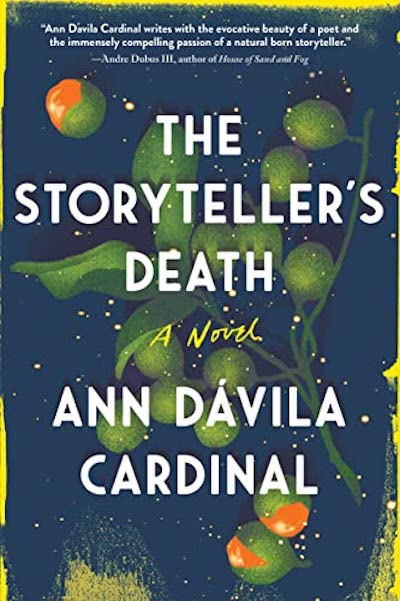
Lens and Sin have big dreams: Sin will be lead bassist for a famous punk-rock band, and Lens will be the professional photographer capturing her greatness. Years later, Lens, now known by her real name, Elena, teaches visual art online from a quiet wooded retreat in Vermont, having put her punk days behind her, or so she thinks. When Eddie Carcinogen, one of NY punk’s biggest stars, dies at the ripe old age of 70, folks are mostly surprised he lived that long, considering his heroin addiction. After Elena is contacted about her photographs of Eddie being displayed at the Guggenheim, her world is shaken. Sin died of an overdose shortly after she fled NYC in 1983, and Elena is forced to confront memories, good and bad. And what a time for her gift, a connection with the dead through touch, to surface. Suddenly, she’s hearing the last moments of other female punk musicians, all allegedly dead from overdoses in the 80s, and she must investigate. Dávila Cardinal weaves magic realism into this gritty mystery that has a unique Nuyorican vibe, leading readers to question everything that Elena must immerse herself in to avenge the women’s deaths. Fans of punk music will be delighted with the playlist provided by the author.—Dodie Ownes
Magical Realism
Book of the Week July 23, 2026
Librarian Claire Ashford is an insomniac, but at least now she has good reason. The rumors are true. Her library, in the town of Foxhollow on the Massachusetts coast, is being redeveloped, the “distant men who [speak] in numbers and profit margins” having more sway than Claire and the townspeople who use the space so lovingly. Besides the world’s most overstepping and boisterous colleague, Grace, Claire has one source of hope: a strange door in the library, which appears only sometimes, leads to a room with books that seem to want to help her. Opening any of the strangely titled volumes reveals a memory of something that happened in the library or the town. If Claire can piece together the stories, can she find a way to save Foxhollow library? Finding out is an engrossing and lovely quest for the reader, one that involves Claire facing real troubles but finding support and perhaps romance along the way. A bonus for librarians: our work and its obstacles are portrayed realistically, except of course for the magical door. Those who enjoy small-town tales and books set in libraries, such as Matt Haig’s The Midnight Library (a Foxhollow patron pick!) or Haruki Muraki’s much more bizarre The Strange Library, will be right at home here.—Henrietta Thornton
Book of the Week June 25, 2026
A massive tsunami hits the Pacific Northwest and sweeps away Annie’s mother and father Maya and Aiden, and there’s not much left of Hale’s Landing, where she is sheltering with her grandmother Ruth. Then Annie discovers a man on the beach, about her age, with slimy, pale skin and strange eyes. As she and her aunt nurse Walker back to health, more questions than answers come up about him, making the townspeople suspicious. Moving back and forth in time from when Aiden first met Maya to the present to time in between, readers will find the lives of of Hale’s Landing inhabitants unfolding across the pages—Annie’s best friend and first love, Evan Hale, trapped by his father Isaac’s logging business; Uncle Henry, gruff and loving; and the chorus, locals who mistrusted Maya even before she and Aiden made the decision to live full-time on a sailboat. Annie can no longer deny that the sea calls her, as it did her mother, and Walker is somehow part of that—but how, and why? What is the connection she is missing? And can Hale’s Landing survive without the logging business that built it? Anderson spins an enchanting and exhilarating tale that will especially appeal to those who love everything about our waters and forests and all that dwell in and around them.—Dodie Ownes
Book of the Week March 19, 2026
Guinevere and her brother, Ennis, have grown up in the shadow of their mother’s success. Edith Sharpe wrote five books in a magical series called The Ninth City, and they are beloved by millions. Their mom used their names for the main characters, and Guinevere and Ennis pretend to love the comparisons between them and their fictional selves. They’re often asked how wonderful it must be to have Edith as their mom, but the truth is that they had a horrible childhood of neglect and fear. They’ve kept their mouths shut for years, and now Guinevere has written a memoir about her childhood that is almost entirely fiction. Ennis works as a famous artist, and the two of them haven’t talked since a night when everything changed. When Guinevere learns about her brother’s newest exhibit, titled MOTHER, she worries that Ennis will reveal secrets that she’s not ready to have public. She begins to remember more as her life starts to unravel. Can she confront her brother and convince him to stay silent? Albert’s novel balances the line between gothic horror, high-stakes thriller, and a dark fairy tale. She uses words like a paintbrush, creating vivid images that will haunt the reader long after. Wow.—Jeff Ayers
Death has gone on vacation here and there, but after she hears about a sabbatical while on a trip across the River Styx, the Boss agrees to her request for a break. Her sister Life gives her the chance to live in human form so she can understand humans better. Now Delara, working as a paralegal at a second-rate law firm in London, is shaken when she discovers an Unplanned Death caused by vampire fish—after all, it’s her department, and the Boss will not be happy if he finds out. She left the temp in charge—is that the problem? Of course, Life is all over Delara, asking how her creations could be snuffed out without regard for the Plan. The days of simply putting folks on the Boat could be over if she cannot find out how this aberration has occurred. No longer in a black sack and carrying a scythe, Delara is hot to get to the bottom of the issue when charming parasitologist Marco enters the investigation. Debut-author Dapunt fills this rollicking story with sideways glances at the afterlife, the underworld, and the Human Communications Director (HCD, aka Jesus). Beyond the central murder mystery, the novel explores themes of life and death, love and relationships, the meaning of existence, and human emotions. Satirical, funny, and packed with wry observations on how humans approach death, and life.
Fraught connections between different worlds hold together this coming-of-age tale: connections between Puerto Rican families in the United States and their homeland; between the past and the present; between the real world and one made of stories. As the book opens, its shy protagonist, Isla Larsen Sanchez, is visiting her mother’s native Puerto Rico. Back in New Jersey, “everyone [looks] so colorless, like the underbelly of a fish,” but at least there she can do her own thing. The island, however, is overflowing with color but also with cheek-pinching aunts who expect proper behavior from a young lady with “not one drop of blood…that is not European.” Over the years, as she spends every summer in Puerto Rico, Isla comes to realize that her oh-so-pure blood may have given her…well, she’s not so sure it’s a gift. She sees visions of tales the cuentistas, storytelling women in her family, have told her—but only after their deaths. When one story involves a murder, and Isla finds that she can be physically hurt by weapons in the visions, readers find themselves dropped into a combination of magical realism, terror, and mystery, all wrapped in a shroud of family secrets and dubious honor. This rich story about stories can work as a crossunder, meaning it can be enjoyed by young adults as well as adult readers; Toni Morrison fans will particularly enjoy the otherworld-tinged drama