How lucky we are to have crime fiction that is as rich in history as it is full of riveting prime suspects. At the center of this narrative is Sir Gabriel Ward KC, longtime denizen of the Inner Temple, “that cloistered little area of London in which the lawyers live.” While Ward’s evenings are rarely spent in the Temple’s library—his own office suffices—the sudden discovery of the librarian’s corpse, spread out on his desk, and the disappearance of a priceless medieval manuscript are enough to set Ward on edge. Add two suspects, Jitendra Shah, an Indian law student; and Lesley Roberts, the shocking assistant librarian, who happens to be a woman, rare in librarianship at the time. Can both be responsible? In addition, of all things, Gabriel has decided to take on the representation of a sweetshop in distress while London prepares for the coronation of Edward VII. Miraculously, several narrative threads come together to resolve a most vexing, and pleasurable, story.—Brian Kenney
Review
Tess has never really felt like she belongs, and that intensifies after her father, Harry’s, tragic, and to her mysterious, death. Her mother is icy cold, and the closest thing she has to a relative, family friend Vivian, remains Tess’s only hope for getting some answers. After her current therapist (Tess recalls them as n-3 or n+2 depending on where they appear in her mental health journey) recommends a return to her childhood home to confront her ghosts, the gates begin to open to her past. Discovering the origins of The Paradox Club and its quest to protect the present from UFOs—untethered foreign objects—and her parents’ and Vivian’s roles blows Tess’s world apart. From Manhattan to South Dakota to Madison, Wisconsin, readers will gallop along with Tess, Vivian, Valentine 6, and other members of The Paradox Club, racing to protect (or is it pursue?) the most dangerous UFO known to personkind before it causes universes to collapse. This is a category-defying novel—a family story and a time-trippy exploration of the universe, populated with inept henchmen and eager helpers in strange yet familiar places, with a gracious bow to the greats of science fiction. Yes, that’s a lot, but Lovett absolutely delivers with humor and style. Fans of Douglas Adams, Matt Haig, and Jodi Taylor will find lots to love.—Dodie Ownes
Book of the Week June 18, 2026
This emotionally resonant standalone by a two-time Gold Dagger winner is Robotham’s most personal book yet. Although this is his 20th novel, the author, as he notes in his acknowledgements, first wrote it in his twenties and then filed it away until he accumulated a lifetime of writing experience to return to the manuscript. After 12 years in prison, Arlo Hackett has returned to see his mother in the small Australian town of Yulara on the Great Southern Road between Sydney and Melbourne. But the self-righteous, small-minded community is not ready to forgive Arlo for his role as an accessory after the fact in the rape and murder of 17-year-old Saxon Winacot, apparently committed by his neurodivergent younger brother, Luke, who later killed himself. Despite the town’s seething hostility, Arlo is determined to stay and fix up his mother’s house for sale after a stroke puts her in a nursing home. When he uncovers evidence that the cops might have brutally beaten Luke to extract a confession, Arlo searches his memories and questions locals to uncover the truth that will exonerate his brother. Alternating between past and present timelines, this is more than an atmospheric crime novel populated with well-drawn characters: It’s a haunting coming-of-age story; a sorrowful tale of lost love, missed chances, and promising lives cut short; and a moving narrative of redemption. Fans of Peter Temple’s The Broken Shore will find much to appreciate in Robotham’s trenchant depiction of small-town Aussie life.—Willy Williams
Facilitated communication is a controversial practice that involves a facilitator supporting the hand of a person who’s disabled and can’t speak, so that they can type instead. Leah Andrews knows it has its detractors, but she believes in it fully and is ready with success stories, including tales of clients she’s helped. It’s no different when she takes on the case of Eliot Martine, a man who’s been uncommunicative since he fell down the stairs at home. His wife Stephanie is hoping to get her husband back in some form, not to mention to get the password to his crypto account. Eliot’s daughters are less excited; they seem to hate Stephanie and doubt that Leah can help at all. But soon Eliot begins to type messages to the family that seem real and include things that only he would know. When he’s alone with Leah, however, he tells her that he desperately needs protection from an abuser. These chapters alternate with the tale of a lonely, naive young woman who’s been swept off her feet by a new love whom readers will see from the outset is sketchy. While the controversy around facilitated communication is a major driver of this plot, the young women characters steal the show, with their inner lives, doubts, and hopes taking center stage. Twists and deception top off the suspense, and you’ll finish this in no time, the pages flying by as a psychological game plays out.—Henrietta Thornton
Welcome to some powerful Nordic noir that is partly a novel of suspense, with the shadow of Agatha Christie, and partly terrifying in its own right. At its center is detective Helgi Raykdal. As Christmas season approaches, Bergþóra, Helgi’s ex-girlfriend, fatally runs over the detective’s new girlfriend, Anita. A violent alcoholic, Bergþóra totally destroys the car and the future Helgi hoped to build with Anita. After a month’s absence, Helgi returns to work in Reykjavik brimming with anger. As someone who was physically abused by Helgi, who insists that Aníta’s death was an accident, Bergþóra somehow manages to walk free. To escape his sorrow, Helgi becomes involved in trying to resolve the disappearance of his predecessor, Hulda, a retired officer long presumed dead. But as the lines begin to blur, the shifts between the past and present merge. Will Helgi’s colleagues accept him back?—Brian Kenney
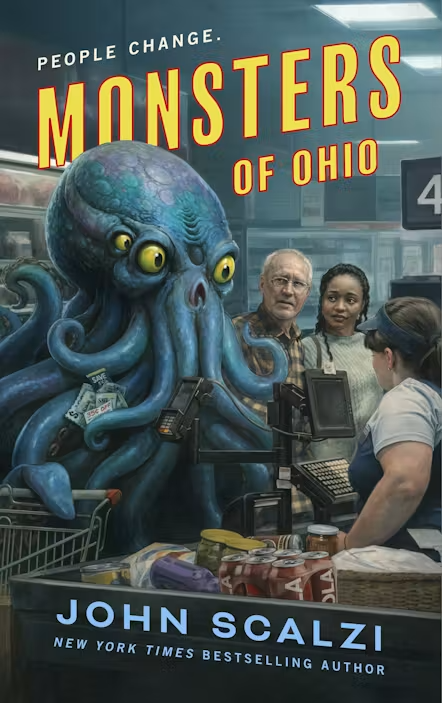
Richland, Ohio is a town on its last legs. With Bradson Foods—its biggest employer—about to close, the community is quietly unraveling. Dave Prost serves as both chief of police and sole police officer. Mike Boyd, recently laid off from the FDA, returns home to stay with his dad and stepmother and immediately senses that something is deeply off about the place he grew up. Meanwhile, a local woman named Andi hatches a plan to revive the town’s fortunes: a festival celebrating Ohio’s legendary cryptids, dubbed the Monster Mash. It’s eccentric, but it might just work—until the missing-pet flyers start appearing, and a cow that should be dead turns up alive and somewhat abnormal. One by one, other animals follow. Then the people start changing, too, in ways that are difficult to explain and horrifying to witness. Scalzi builds a quietly devastating portrait of rural decline and populates it with a cast that feels genuinely real—ordinary people blindsided by the extraordinary. The horror creeps in slowly before going full throttle, and the author never loses his grip on the humor that keeps things from becoming relentlessly bleak. Think Twilight Zone by way of The Thing: unsettling, darkly funny, and impossible to put down.—Jeff Ayers
After losing her reelection bid, Sheriff Jenny Almond makes a solo trip to meet Anthony Alvarez, who has called her with a cryptic message. What she finds upon arrival changes everything—a gunshot rings out, a shadowy figure emerges from the darkness, and in a split-second decision, she pulls the trigger. Alvarez is dead, and Almond is facing the unthinkable: a first-degree murder charge for allegedly shooting an unarmed man. Desperate for answers, Almond turns to her trusted friend, Seattle detective Tracy Crosswhite. With Tracy’s attorney-husband Dan stepping in as her legal defense, Tracy launches her own parallel investigation into what really happened that night. The trail leads somewhere unexpected—back more than four decades to a chilling cold case in which Alvarez was the prime suspect in a teenage girl’s disappearance, a wound that never fully healed for the surrounding community. Dugoni masterfully illustrates how a single moment can irrevocably alter the course of lives, weaving together past and present with the kind of propulsive, assured storytelling that has made his Tracy Crosswhite series a standout in modern crime fiction. Whether the action is unfolding in a courtroom or out in the field, Dugoni keeps the tension taut and the pages turning. Long-time fans will find this latest installment deeply satisfying, and those coming to the series fresh will quickly understand why Dugoni has earned his place among the genre’s elite.— Jeff Ayers
Ireland in 1970 is teetering on the edge of being a good place for women, but it’s not moving quickly enough for Nicoletta Sarto, who’s on maternity leave from her journalism job at Dublin’s Sentinel. As the book opens, she’s due back at work in a week, but stuck between two forces: her boss wants her back early, and everyone else, from her useless partner, Barney, to her coworkers and family, thinks she should stay home with her new twin girls. Nicoletta does whatever she wants (hooray!), and she’s soon back at work, patching together daycare from various reluctant family members while pursuing a crime story. (Never mind that she’s supposedly working on the newspaper’s “womens’ pages.”) The story of murder and stolen art, interspersed with looks at women’s rights (not many), class differences (too many), and organized crime (ditto), takes an unexpected turn and is followed by a surprising and lovely coda showing Nicoletta post-chaos. A fast-moving and interesting look at the recent past, with a gritty character to cheer on–get this on your TBR. In the meantime, try the first in the series, Where They Lie, which features Nicoletta in the ‘60s.—Henrietta Thornton
Book of the Week June 4, 2026
Nicola’s father has been arrested for a series of murders of women in her small town 20 years ago, including the killing of Nicola’s best friend. Nicola was even part of implicating her father, by participating in the To Catch a Killer podcast that uncovered his identity as the murderer. Now, Nic has lost her job teaching art, the house she grew up in is being foreclosed on, and the press is full of vultures. But a late night text inviting her to The Death Row Club retreat—members must be children of serial killers—brings the promise of support, community, and maybe even friends. The podcast host, Greer, herself the child of a serial killer, will also be at the retreat, with six other members. What Nic thinks will be a cozy support group weekend ends up with one of the group dead after a stranger to them, with valid credentials, appears. Given its alternating points of view and fractured timeline, readers will have to stay on their toes to keep up with this tense, tightly wound, and layered thriller in which each character seemingly has the motivation to kill. While Vasquez weaves in social commentary on the death penalty, the public’s fascination with serial killers, and the grief of the victims’ families, it hovers just below the surface of this unique and intricately crafted debut.—Dodie Ownes
With a title like this, how could a book be anything but a bit zany? Daphne, named for the Scooby-Doo character, fresh from a forensic journalism degree and a failed hope of a job, arrives in Reno. Her great-aunt is reviving a scandalous rag of a newspaper into something that reports high-society events. She has a classic meet-cute with her hunky fellow staffer, though strives to keep her libido in check and just be a colleague. Their first assignment is to cover a wedding at a rural Oregon resort famed for its sasquatch sightings. The owner of the lodge is marrying a woman nearly 30 years his junior and, despite a pre-nup, his family is outraged. Because of a booking error, our duo must share a lavish but outdated suite complete with a champagne-glass bathtub and a secret passage. Of course, there is a missing hotel maid, bigfoot sightings, and a whiff of (get this!) real-life fugitive D.B. Cooper. Our intrepid reporter ferrets out the clues and solves this in Scooby-Doo fashion with the assistance of dogs. Silly and light as a feather, sure, but lots of fun.—Danise Hoover