
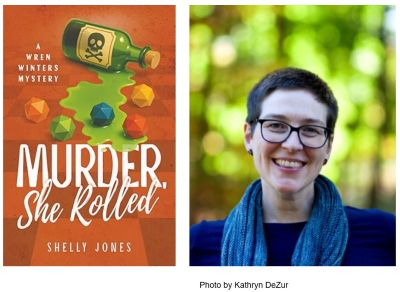
Shelly Jones published the second book in their Wren Winters Mystery series, Murder, She Rolled, in October. We caught up with Shelly to ask a few questions about their book and how a one of its central themes—board games—can bring together libraries’ book and board-gaming clubs.
We’d love to hear about the book and the series—your inspirations, characters you’re enjoying writing, all the things that make it yours!
Thanks so much for the opportunity to share about Wren and her friends. They are a close-knit group that meet up at Wren’s board game shop, the Cardboard Sheep. The friendship between Wren, Charlie, Esther, and Jo is, I think, the heart of the novels. I loved writing them so that they all complemented one another, the way true friendships do. Wren is introverted, but keenly perceptive and willing to do anything to help her friends. Charlie is clever and tech savvy with an engineer’s brain. Fueled on caffeine and snark, Esther keeps the group lively, pushing folks out of their comfort zone. And Jo keeps the group steady and makes sure that no one leaps to conclusions (even as they all leap into a murder investigation together).
The series began with Player Elimination, in which Wren’s cranky landlord is found dead in her store, leading her to investigate what happened. Murder, She Rolled starts off with the death of a new friend as the gaming group livestreams a role-playing game. When another member of the group falls ill, Wren is determined to solve the puzzle before her friend’s game is over for good.
Cozy mysteries and board games seem like a match made in heaven, especially for a “nerd by design,” as you describe yourself. Can you tell our readers more about your interest in both of these pursuits?
Like my protagonist, I’m a big fan of board games. My book collection rivals my game collection, which rivals my yarn stash… I’ve always loved mysteries, but for some reason it hadn’t occurred to me to try to write one until a few years ago. Until then I had been mainly writing short speculative fiction. But the idea of a nerdy cozy mystery focused on board gaming sparked my imagination and I knew I had to write it.
Playing a game with someone requires a lot of trust. We expect that everyone will play by the rules and that no one will flip the table if the dice never roll in their favor. Reading a murder mystery also requires a level of trust. We have faith that the clues won’t be too obtuse or lead us too far astray, and that the ending will be satisfying: the murder solved, the detective victorious. In that way, gaming and a cozy mystery do seem an excellent match up.
Speaking of a match made in heaven, a library program that brings the book club and the board-game club together…sign me up! Are there particular games that would work well with this book?
As I was writing, I found myself coming up with fictional games for Wren and the others to play. I now have a spreadsheet of dozens of fake titles with the basic mechanics of the games listed out. I did this for a few reasons: one, it was just fun to do! And two, I worried if any particular game was tied to a murder (or two) that might not be great marketing for a specific title, and I didn’t want to mar any of the amazing existing games out there. So fictional games became my go-to.
In real life, I have to give a few shout outs to some cozy, library-friendly games:
Calico is a puzzly, tile-laying game of quilts and cats. If you like tile-laying but not quilts and cats, Cascadia is a nature-themed tile-laying game that scratches a similar itch.
Paperback (or Hardback – both created by the same designer, Tim Fowers) is a deck-building, word-building game that any bibliophile will enjoy.
MicroMacro is fun for all ages as players try to find clues in a busy Where’s Waldo/Richard Scarry-esque scene and solve a mystery.
Psychic Trash Detectives is a whimsical indie role-playing game that can be played in one sitting. Players take on the roles of raccoons, opossums, crows, or other ‘trash animals’ that must root through collected trash (literally—think: recycling, old newspapers or magazines) to find clues to solve a mystery. My students are playing through this now in class and are having loads of fun.
Can you suggest some questions or themes that the book/board game group can discuss while they play?
The history of games is fascinating, from knucklebone dice to Senet and Go, to Elizabeth Magie’s The Landlord’s Game as a precursor to Monopoly. Games often have been about more than mere entertainment. They are deeply rooted in and a reflection of the culture that plays them (e.g. Senet reflected Egyptian religious beliefs; expertise in Go was a qualifier for service in Chinese bureaucracy; Magie’s game highlighted the perils of capitalism). As a much more recent example, folks might be interested in how the popular creators of Cards Against Humanity are supporting libraries and the fight for free speech through their Cards Against Humanity Explains the Joke.
Aside from the history of games, people might want to think about how they could design a game themselves. A lot of libraries have “maker spaces” that can be creative havens for emerging creators. The nice thing about board games is they don’t require a lot of tech or complicated materials. I’ve made a game with just a few pieces of paper before. But having a community and safe space to explore and playtest is key. What better place could there be for that than a library?
Shelly Jones is a professor by trade and a nerd by design. Woefully introverted, their pockets are full of post-it notes and their head is full of (unsaid) witty come-backs and un-won arguments from years past. When they aren’t grading papers or writing new cozy mysteries, Shelly can often be found hiking in the woods or playing a board game while their cats look on. You can also connect with Shelly on Bluesky, Instagram, and Goodreads!
