
If you are an avid reader or (hopefully!) a firstCLUE subscriber, you may have noticed that books come with a lot of extras from their publishers. This usually includes the ISBN, number of pages, release date, and of course—tags.
Tags, also known as BISAC Codes, are the words and short phrases that describe a book based on its themes and genre. Tags are useful for publishers and readers in identifying common tropes within books. They also let readers know that they might find exactly what they are looking for in a particular title.
BISAC, or Book Industry Standards and Communications, Codes come directly from the publishers and are predominantly used by librarians and booksellers to properly shelve and categorize books. Tags are commonly difficult for authors to choose for their own works because there are a limited number approved by the BISG (Book Industry Study Group). All official tags come from this community of book lovers, which leads the industry in best practices, research, education, and events. BISG has a list of more than 50 possible tags for authors to choose from to identify the themes of their work. Examples of these include: Cooking, Fiction, Social Science, and True Crime. They are each expanded further to identify more-specific themes within these categories. For example, a full BISAC Code may read “FIC022170 FICTION / Mystery & Detective / Cozy / Books, Bookstores & Libraries”.
Here’s where it all comes back to you! As an avid reader, you can use these tags to determine if you will read a book or not. At firstCLUE, we identify these tags within our review database to help you find coverage of the books you have the best chance of loving. While all of our books fall into the crime-fiction category, their tags differ greatly across the genre. You may have seen a recent article from us about books in the recently popular crossover subgenres of Supernatural Cozies and LGBTQ+ Amateur Sleuths. The increase in the crossover of tags is growing each year as authors continue to create unique stories in ever-more-niche subgenres to share with their readers. At firstCLUE, we highlight these tags for you, just as libraries and booksellers do, because we want you to find the books that best fit your needs as a reader.
Some of our favorites that we have recently reviewed include:
The Midnight Shift by Cheon Seon-Ran. Translated from Korean by Gene Png. August 12, 2025. Bloomsbury.
Reviewed by Willy Williams in firstCLUE May 1, 2025.
Tags: Book of the Week, Dark Fantasy, Fantasy, Korea, Lesbian, LGBTQ+, Paranormal, World Literature
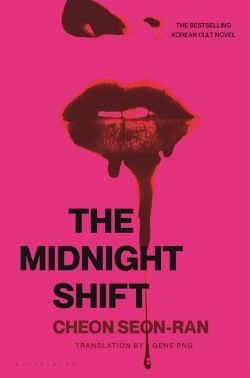
In this Korean bestseller, police detective Suyeon is called to the scene of the fourth suicide of an elderly patient at a crumbling hospital in a deserted part of Incheon. Her boss believes the deaths, spurred perhaps by pervasive depression and loneliness, are coincidental and sees no point in investigating further, especially since their families had abandoned the dead. But Suyeon thinks something is off. All four victims, who suffered from dementia, jumped from the hospital’s sixth floor, but very little blood was found at the spots where they landed. Returning to the hospital later that evening, Suyeon encounters a mysterious Korean-French woman named Violette, who tells her, “A vampire did it.” A skeptical Suyeon angrily dismisses Violette until the autopsy of a fifth suicide reveals two puncture holes in the victim’s neck and the body drained of blood. Claiming to be a vampire hunter, Violette explains to Suyeon that someone at the hospital is helping a vampire target his next victims. As Suyeon seeks to identify that particular nurse, the narrative shifts back to 1983 France, when a teenage Violette, adopted by loving French parents but feeling isolated and lonely because of her Koreanness, begins a strange, intense, almost Sapphic friendship with the enigmatic, barefooted Lily. Skillfully translated (but a glossary of Korean terms would have been helpful), Cheon’s novel is more than a queer paranormal mystery (the inconsistent vampire elements are its weakest parts); instead, it’s an eerie and bleak portrait of societal loneliness, isolation, and marginalization.
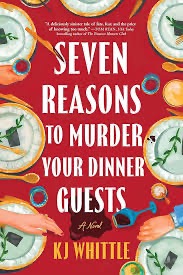
Seven Reasons to Murder Your Dinner Guests by KJ Whittle. September 9, 2025. Sourcebooks Landmark.
Reviewed by Dodie Ownes in firstCLUE July 10, 2025.
Tags: Amateur Sleuth, Debut, Mystery & Detective, Psychological, Thrillers, Traditional

When Vivienne, an admittedly dowdy and somewhat bitter middle-aged magazine editor, receives a mysterious invitation to a dinner party, she almost throws it away. Reconsidering, she goes to the elusive address to find Serendipity, which appears to be a pop-up fine dining experience. None of the other six guests has any relation to her, or one another, it seems. Readers get to know them through their actions and words, and it would be easy to start guessing what is to come, but the highlight of the dinner is when each finds an envelope at his or her place setting. Janet, the most spontaneous (and likely most drunk) of the guests, tears hers open to find a card that states You will die at age 44, and she is just weeks from her 45th birthday. Fear, accusations, and incredulity sweep across the group, and then, dismissing it as a publicity stunt, they depart. But then the words on the cards start coming true. As the guests tell their stories and admit to their sins, readers see Vivienne emerge as a caring and clever amateur sleuth who finally has a family to protect. A terrific addition to the current trend of If you knew you were going to die, how would you live your life? Novels.
The Tutor by Courtney Psak. August 7, 2025. Hodder.
Reviewed by Henrietta Thornton in firstCLUE June 25, 2025.
Tags: Domestic, Mystery & Detective, Psychological, Suspense, Thrillers, Women, Women Sleuth

The tutor is Isabel, a young woman who’s just started her new job at a rich Florida private school. Readers know that she’s angling to meet the Caldwells, a family whose son, James, attends the school; we follow along as she visits their palatial home for the first time, snooping while there—but what’s she up to? In the meantime, we meet Evelyn, James’s mean-spirited grandmother. Her daughter-in-law Rose, the female lead here, can’t do anything right, and in Evelyn’s view is a gold digger who needs to be out of the picture. The man between these two women is too busy with his finance work to be of any help, and the situation disintegrates as Isabel reveals the reason she wants to know the Caldwells and Rose finds out that her mother-in-law is rumored to have too many mysterious deaths in her tiny circle. With secrets and twists coming fast, not to mention emotional stakes that build to fever pitch, this is psychological fiction at its best.
What We Can Know by Ian McEwan. September 18, 2025. Knopf.
Reviewed by Henrietta Thornton in firstCLUE July 31, 2025.
Tags: Apocalyptic & Post Apocalyptic, Literary, Romance, Science Fiction

Be happy, be academically successful, do the right thing—in McEwan’s tale of the mystery surrounding a lost poem, you can only have two. The poem, and those surrounding it, have two lives here. The second part of the book takes place in 2014 at the time of the poem’s creation and involves narcissistic poet Francis Blundy; his wife, Vivien; and their circle. The first part of the book is set in 2119, when humanity has been beset by global warming and nuclear wars. The diminished world is fixated on the (perceived) better past, part of that obsession being Blundy’s poem, which has a place in the culture as the pinnacle of romance and dedication. McEwan spins the reader in circles, showing us the same events first from afar and then from different points of view in the same time period. This creates a sense that what we can know is in fact very little, and maybe that’s for the best. As usual in McEwan’s books, especially his ultra-tense On Chesil Beach, the characters move in such agonizing situations that the book must be set aside at times—but the language, especially concerning characters’ self-regard, whips the reader back in (“…it was no longer me at all. What remained was not even a woman but a poetic convention, the shadow of a woman on the cave walls of a man’s imagination”). A must for McEwan fans; and librarians, take note: the creation and maintenance of an archive has a role here.
The Dancing Face by Mike Phillips. August 12, 2025. Melville House.
Reviewed by Henrietta Thornton in firstCLUE July 24, 2025.
Tags: African American & Black, Mystery & Detective, Political, Thrillers

The darkness of this novel—which was published in 1997 in Britain but is now seeing its first U.S. publication—is paired with an urgency: things must be made right. The England-based Committee for Reparations to Africa has been “veering between sycophancy and rage according to the circumstances” in persuading the British that African artworks stolen during Colonial rule must be returned. The only result is undisturbed exhibits in British museums, so now Gus, a university professor, has decided to make a statement. In partnership with a steel-willed, rich Nigerian man, Dr. Okigbo, he will steal a mask (one that causes “an aura around his nerves” and “The taste of a smell. A ghost in the mouth”) from a renowned collection. He’ll hold it for a ransom to be paid to Africa, but more to stir political fallout. (It’s better than bombing the museum, his initial idea.) Of course, nothing goes to plan, and while the aftermath gets more twisted and scarier, confounding issues are introduced. The mask should eventually be given up, but not to “some bunch of evil dictators.” It might never be possible to persuade the British to do anything (“Nothing to do with us, old boy”). And are Black English people, such as Gus, authentic enough to be involved in this effort? There’s lots to think about here with characters who shake up assumptions and stereotypes along the way.
Breathe In, Bleed Out by Brain McAuley. September 2, 2025. Poisoned Pen Press.
Reviewed by Dodie Ownes in firstCLUE July 17, 2025.
Tags: Dark Humor, Ghost, Horror, Occult & Supernatural, Psychological, Thrillers, Slasher, Suspense

Maybe Hannah’s best friend Tess is right—a restorative yoga retreat in Joshua Tree might be what Hannah needs to let go of the images of her fiancé’s horrific death, right after he proposed to her in a stunning wilderness setting. On the women’s arrival in the desert, all seems idyllic—the sound bowls, Guru Pax in his flowing robes, the yurts and tech-free environment. But soon Hannah’s nightmares about Ben’s death are supplemented with visions of Waylon Barlow, an ancient miner with a flesh mask and a pick axe. The other retreat attendees, including Hannah’s high school ex-boyfriend Miles; tech-bro Jared and his ethereal partner, Luna; and Dennings, an ex-Marine, start to sense that something is off. Pax’s assistant, Kimi, assures them all is well—but then Dennings disappears. In superb Final Girl form, the retreat attendees get picked off one at a time, in entertainingly gruesome ways. As Hannah struggles to survive and save Tess, she has to confront her own secrets. Author McAuley, winner of Esquire’s Best Horror Book of 2022, Curse of the Reaper, demonstrates once again his flair for cinematic suspense with humor and splatter.
Crown City by Naomi Hirahara. February 17, 2025. Penguin Random House.
Reviewed by Brian Kenney in firstCLUE July 31, 2025.
Tags: Amateur Sleuth, Asian American & Pacific Islander, Historical, Mystery & Detective

Set in 1903 Pasadena and told through the eyes of 18-year-old Ryunosuke “Ryui” Wada, who has recently arrived from Yokohama, Japan, this novel is rich in dualities. An orphan, Ryui is fascinated by the world around himself—including Jack, his talented roommate and photographer and Gigi, a beautiful seamstress. Trained as an artist, Jack manages to find work in Pasadena’s art community as an apprentice, a job that takes him all over town. “In America, or perhaps especially in California, people could be transformed into anyone they dreamed of being.” Pasadena is rife with cultural appropriation; one of the personas Ryui encounters involves young white women re-creating Japanese culture, “which made me feel uneasy and confused,” Ryui notes. But when he and Jack are hired by Toshio Aoki, Pasadena’s best-known Japanese artist, to recover a missing painting (“I could be the first Nipponese detective in this country,” crows Jack) they willingly enter a world where danger abounds and real historical figures have a role. Poignant, marvellously well imagined, and deeply moving, this latest from Hirahara, author of the Edgar Award-winning Mas Arai series, and more recently the writer of Clark and Division and Evergreen, is sure to engage fans of historical fiction.
To stay updated on all the latest tags and releases, subscribe to firstCLUE! Stay on the lookout for upcoming updates to our webpage, including an updated searchable database that will allow readers to more easily discover books with the tags they are most interested in reading! Please reach out to us at info@firstcluereviews.com with feedback on these updates and anything else you would like to see from firstCLUE.
For more information and a complete list of BISAC Codes approved by the BISG, visit BISG.org.
